To measure is to know
Designing a nature-inclusive neighbourhood is one thing. Demonstrating that it actually functions ecologically is another. At Happy Days, we are trying to do exactly that - not by relying on assumptions or intentions, but by measuring, observing, and, where necessary, critically evaluating our own design choices.
Together with ERA Contour, Ecogroen, and the residents themselves, we are investigating whether the design principles we have implemented truly deliver ecological and social value. Over the next two years, a series of articles about this research will be published regularly on our website. This edition focuses on the different habitats found within the neighbourhood.

From ‘green space’ to habitats
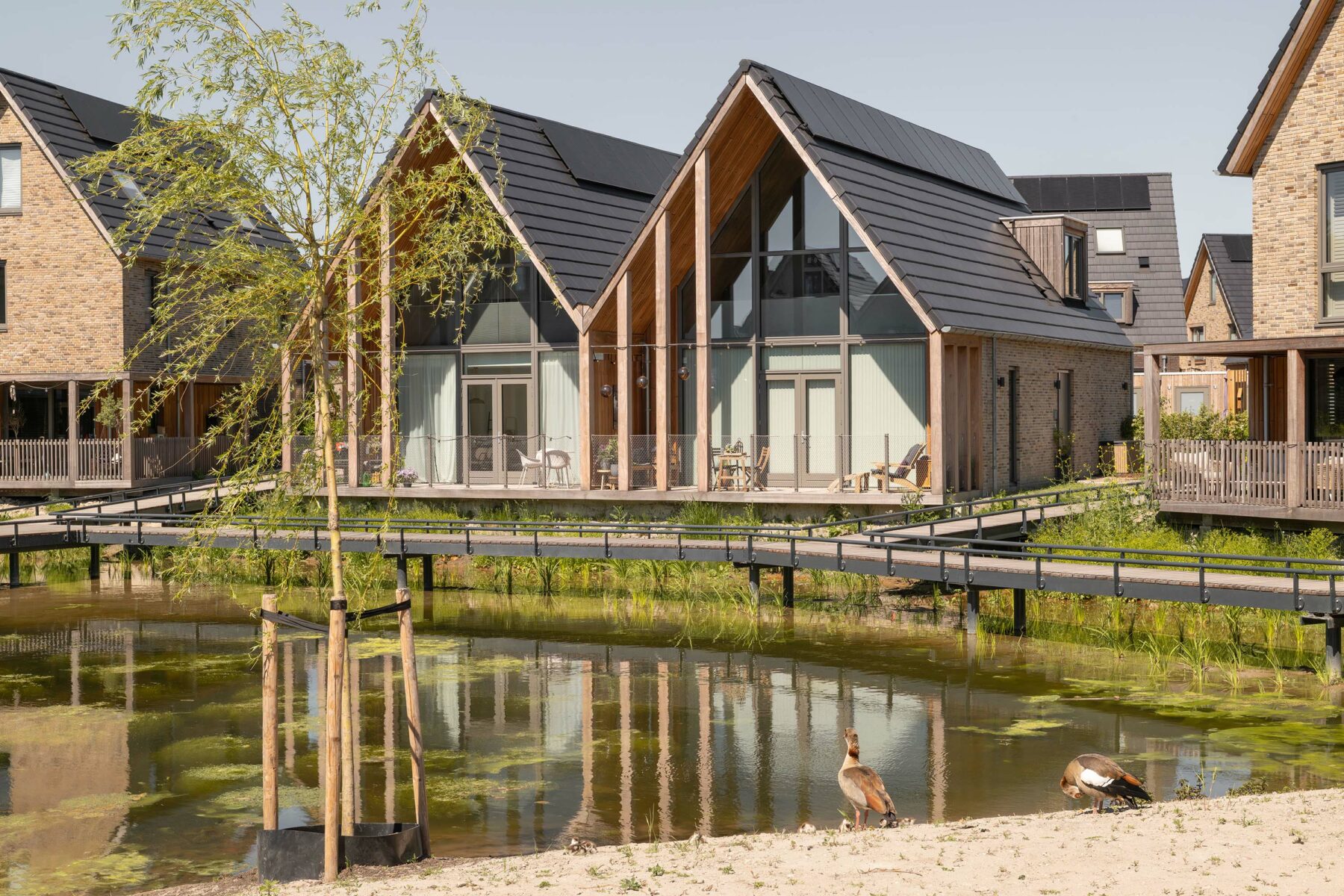
A neatly mown lawn or a planting bed consisting of a single species: urban green space often provides only limited value for biodiversity. In Happy Days, we deliberately chose a different approach. From the very beginning, this residential neighbourhood was designed as a place where people and wildlife can coexist naturally. Green space is therefore not merely a backdrop, but has been consciously designed as an interconnected system of diverse habitats.
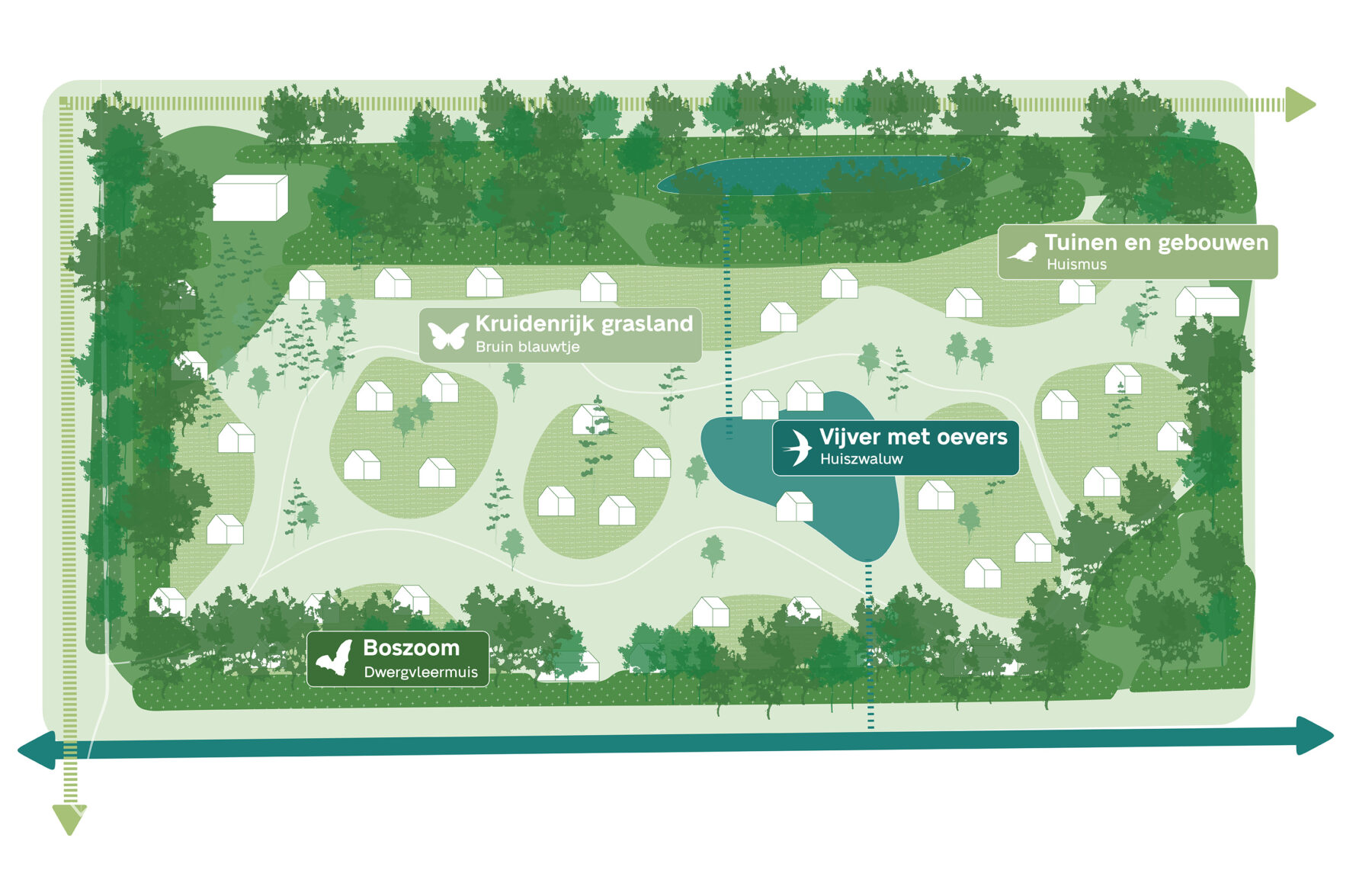
This approach requires integrated design. A habitat is not an isolated element, but encompasses the entire living environment, including the specific conditions that enable species to survive, grow and reproduce. A nesting box without access to food or shelter is not a habitat, but merely an isolated intervention. The habitats selected for Happy Days are inspired by the landscapes surrounding Zoetermeer. Within the neighbourhood, we distinguish four habitat types:
- The woodland edge, supporting species associated with large trees and shrub vegetation.
- The ponds and their banks, supporting aquatic and water-dependent species.
- Species-rich grassland, providing habitat for a wide variety of plants and insects.
- Buildings and private gardens, supporting species that depend on the built environment.
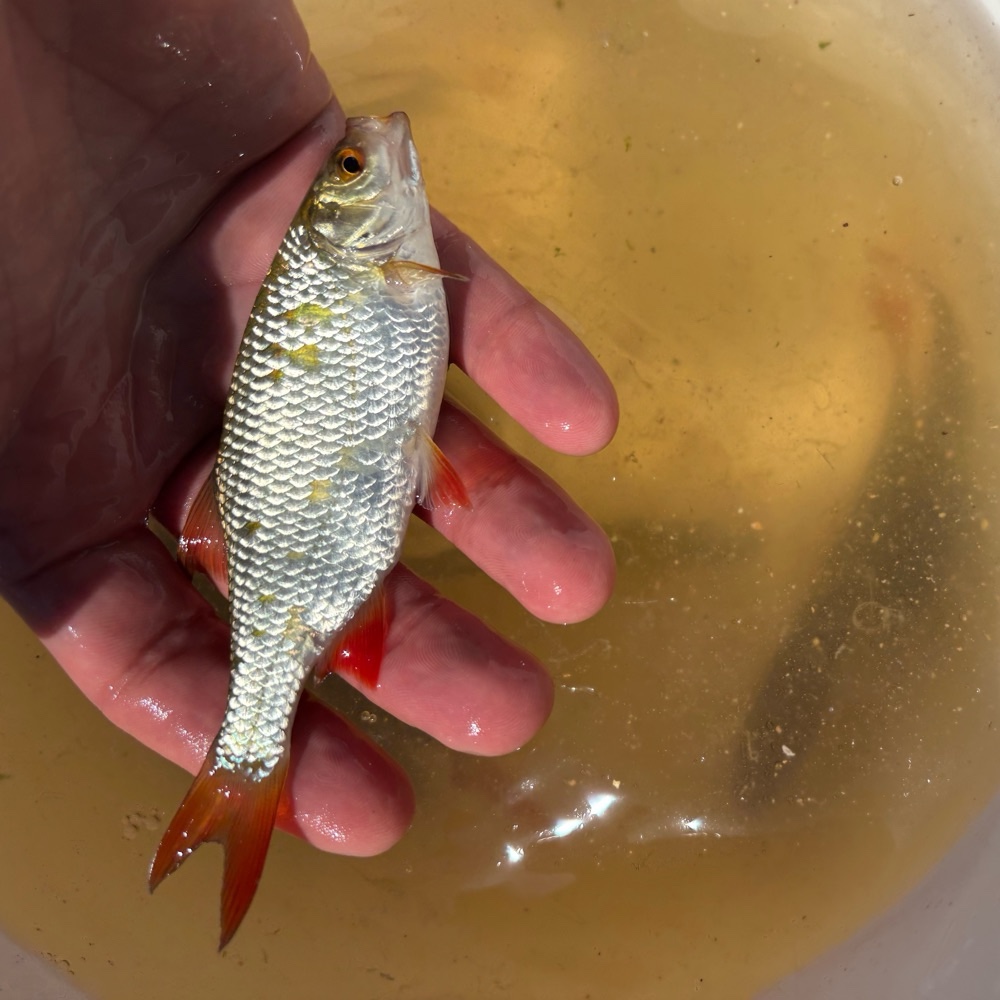
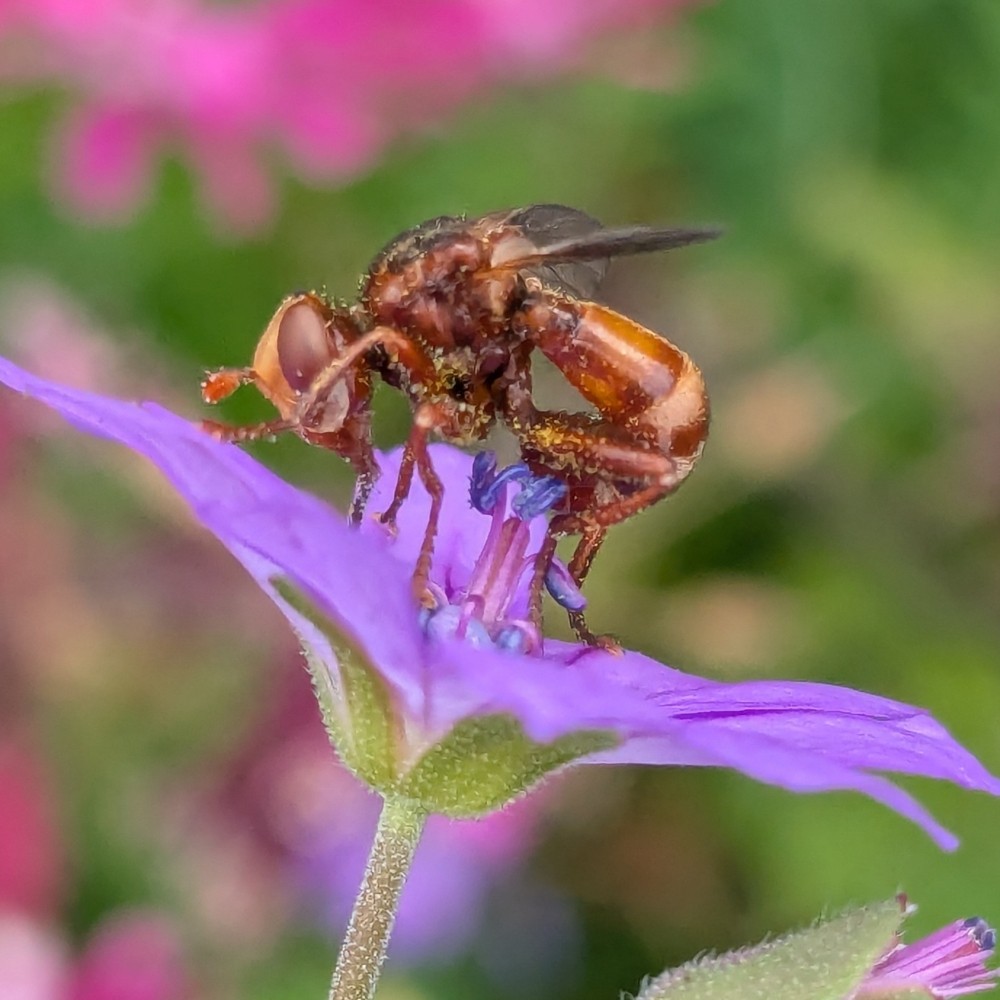
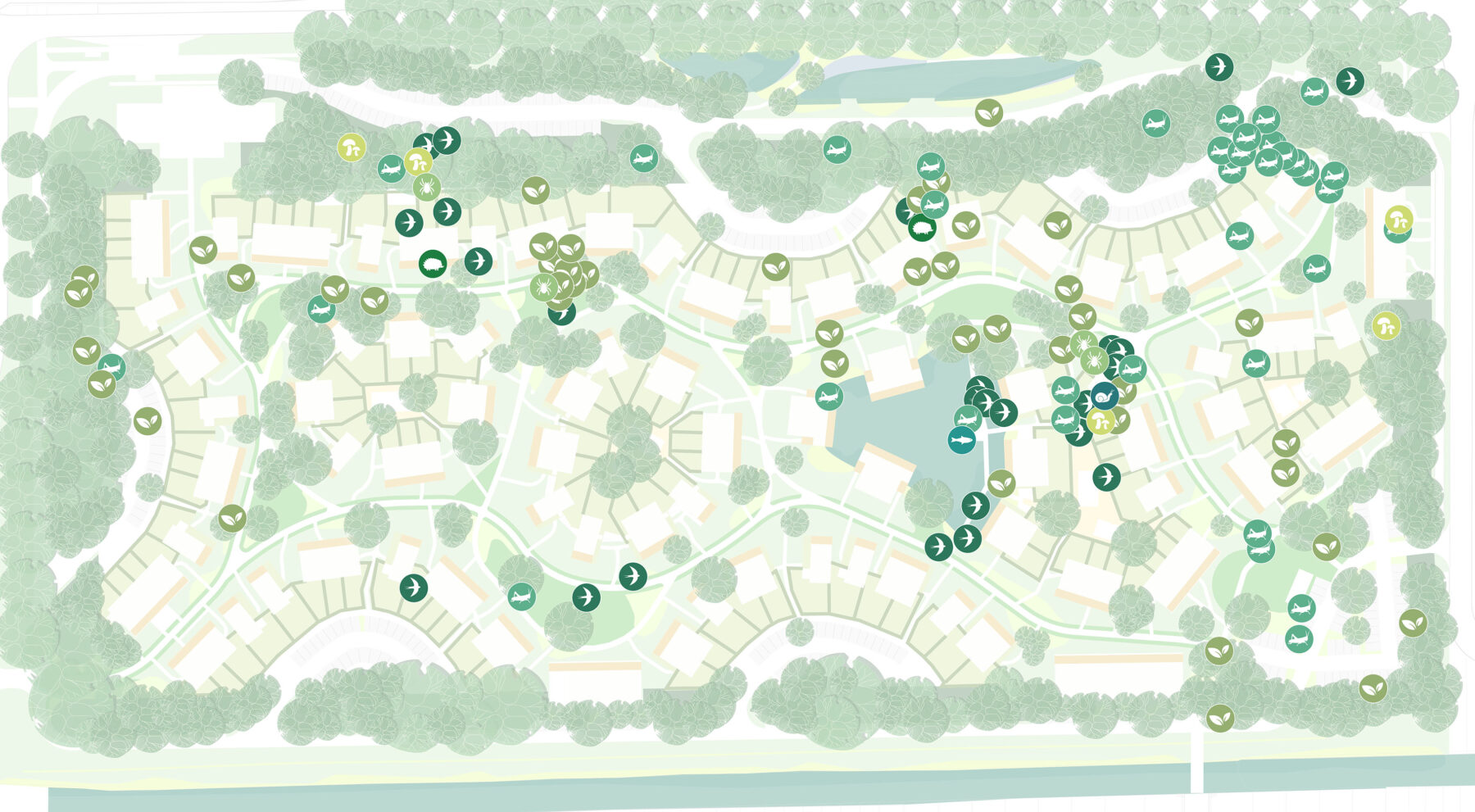
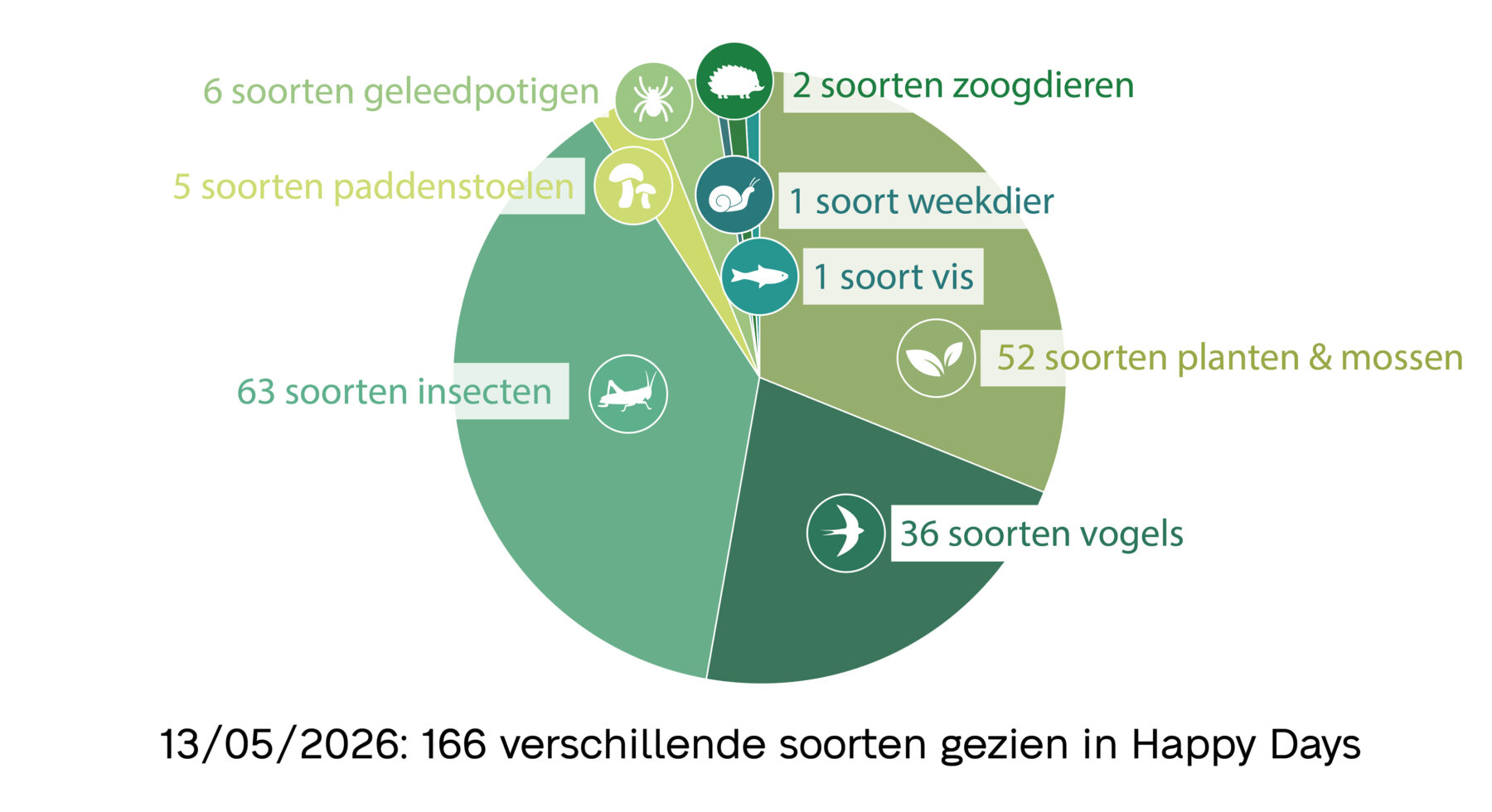
However, the design of these habitats is only the first step. Ultimately, what matters is how these habitats develop in practice. That is exactly what we are currently measuring as part of the multi-year research project. Most of the observations being submitted today come from the residents themselves. So far, more than 160 different species have been recorded, primarily plants (51 species) and birds (36 species). We do see that observations within the area are clustered around a number of homes. This is likely not because certain habitats support more or fewer species, but because most observations are made by residents in the immediate vicinity of their homes or in their own gardens. We therefore also conducted our own field surveys throughout the area to collect observations from as many locations as possible. The ecologist is currently investigating which ambassador species have successfully established themselves in the neighbourhood. Their presence is highly significant, as they only appear once the underlying food web and habitat conditions are functioning properly.
Based on the observations collected so far, we can already see that not all habitats are developing at the same pace. Some species, for example, can be directly linked to a specific habitat. Conversely, the absence of certain indicator species can also provide valuable information about the health of a habitat. The following patterns stand out for each habitat:
1) Woodland Edge
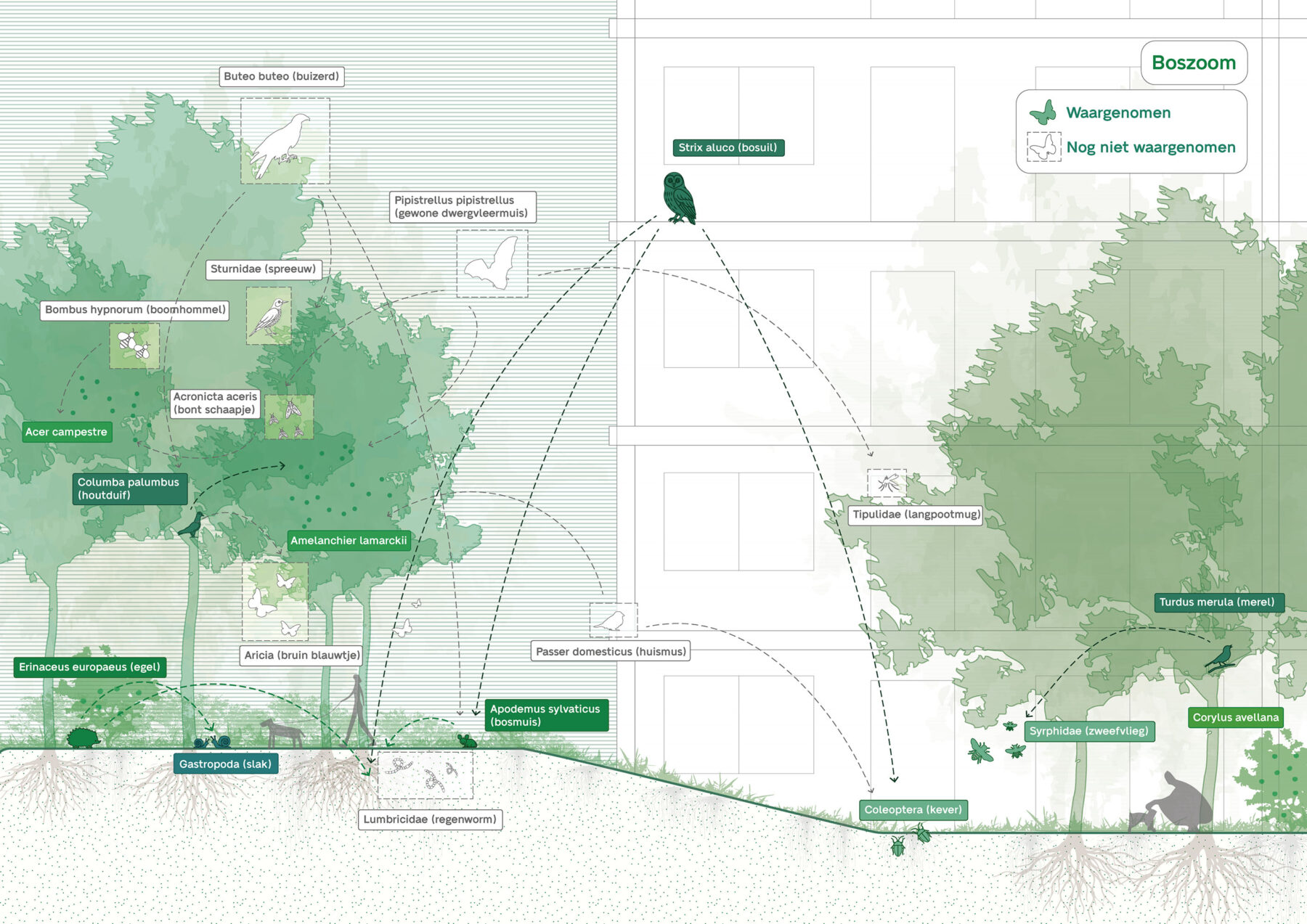
The woodland edge forms the green boundary around Happy Days. The large existing trees already provide shelter, food, and shade. At the same time, there is a limitation: a large proportion of the existing trees belong to the same species, namely the Canadian poplar. The newly planted species are intended to increase diversity over time, but are currently still too small to make a significant difference. Once these trees mature, they will cover the ground with a thick layer of fallen leaves. This leaf litter will become an important habitat for soil-dwelling organisms. Insects, fungi, and other small organisms will form the foundation of the future food web.
Although several top predators have already been observed, such as the common buzzard and kestrel, sightings of more specialist species are still lacking. This also applies to the area’s ambassador species, the common pipistrelle bat. At present, there are likely too few nocturnal insects to attract bats. It is also possible that these species have simply not yet been observed by residents, as they are primarily active at night. Later this year, Ecogroen will conduct targeted bat surveys, and we hope to be able to report that they have been recorded.
2) Ponds and shorelines
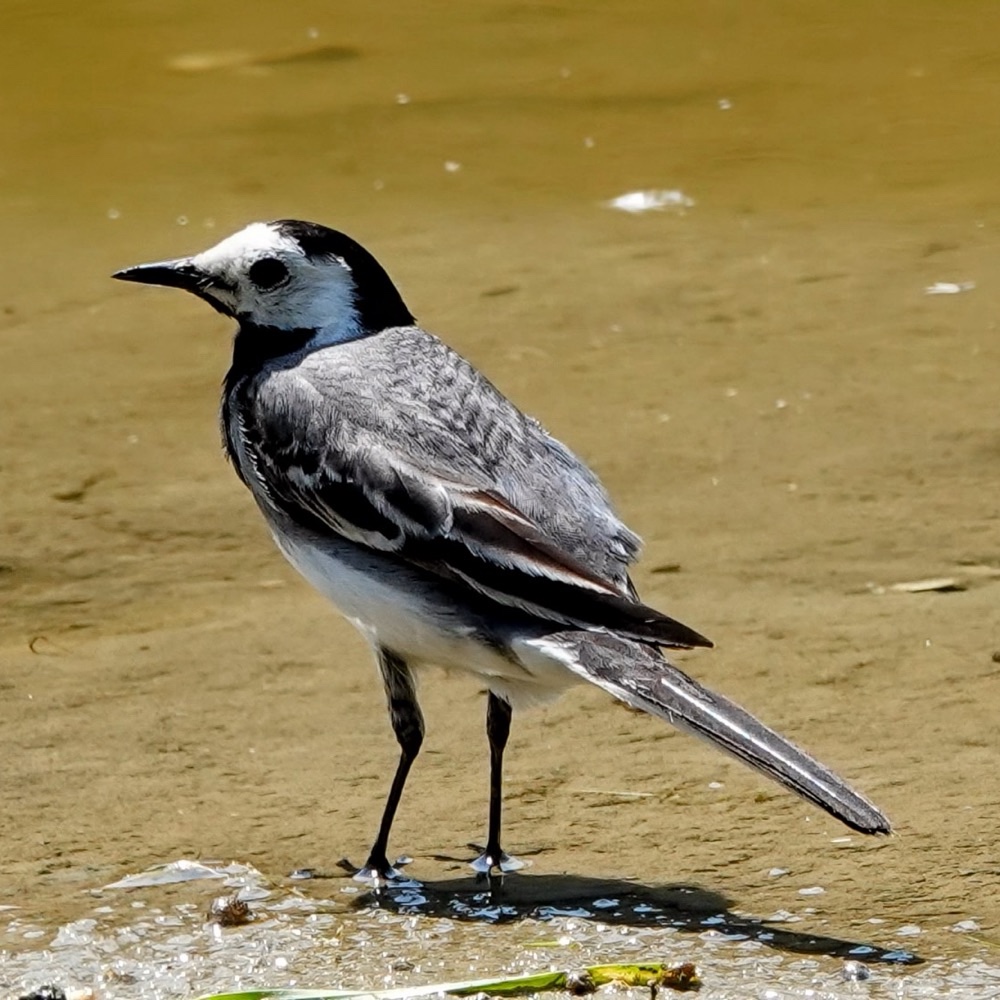
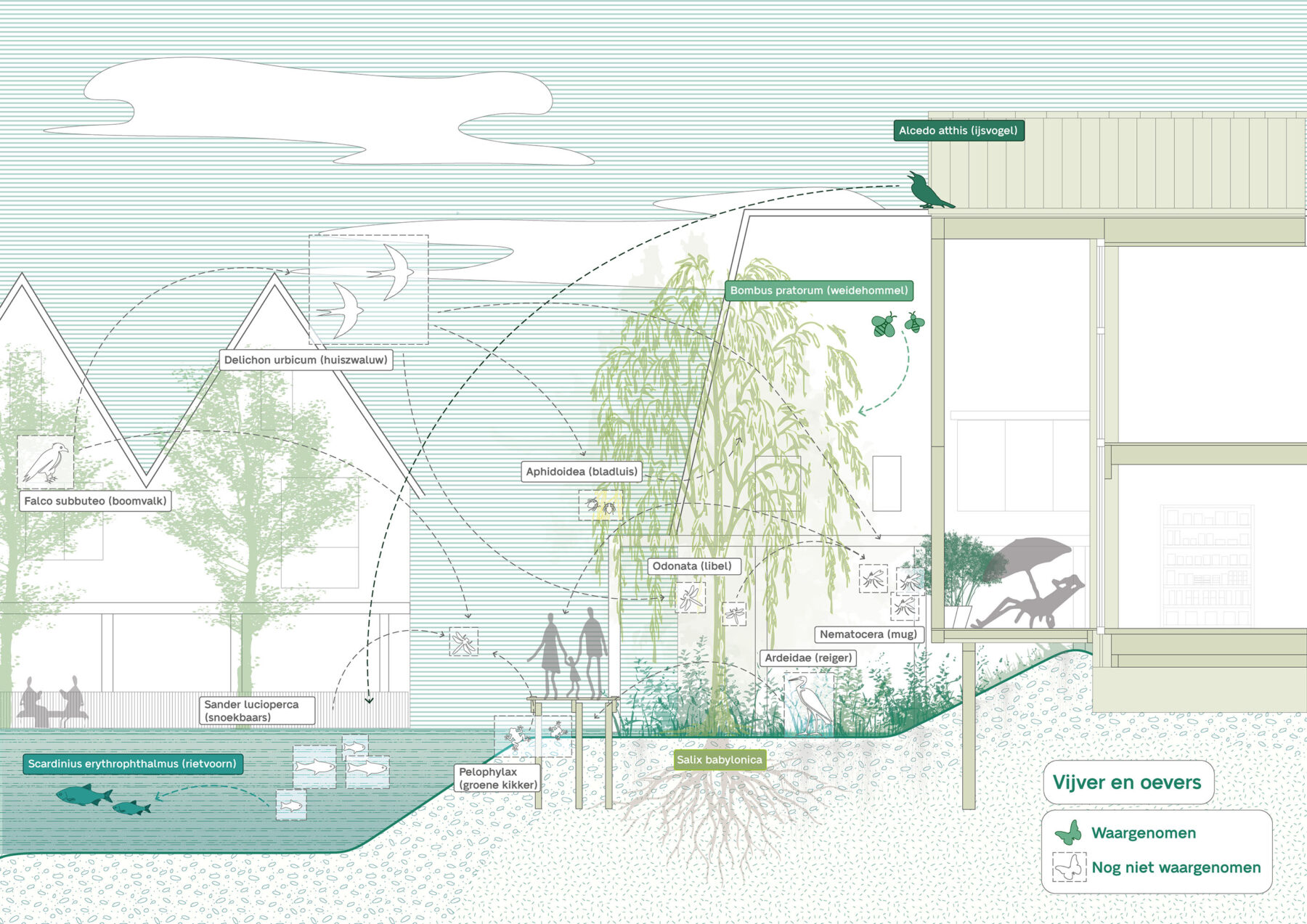
The pond is already functioning as a clear ecological attraction within the landscape. The presence of at least six bird species can be directly linked to the availability of open water. Species such as the kingfisher, mute swan, grey wagtail, and common moorhen confirm that the pond is already adding ecological value. At the same time, life below the water surface remains limited. Species indicative of a mature and healthy aquatic ecosystem, such as amphibians and specialist aquatic insects, are still absent. This likely has several causes. For example, the pond is connected to existing water structures only through a long culvert, which may act as a significant barrier and restrict biodiversity development.
Although the barn swallow has been designated as an ambassador species, the originally planned nesting sites do not appear to be present everywhere. Some may have been removed by residents. This is currently being investigated further in consultation with the ecologist. Notably, the grey wagtail has already been observed. The possibility of installing additional nest boxes for this species, as well as reinstating nest boxes for the barn swallow, is now being explored.
3) Species-rich grassland
The species-rich grassland is a habitat that must essentially be created from scratch. Intensive construction activities have severely disturbed and compacted the soil. This habitat also demonstrates how resilient nature can be when given the opportunity. Once construction was completed and heavy machinery had left the site, seeds from the surrounding area began to germinate, quickly creating a green cover of pioneer vegetation. Observations of species such as hairy bittercress, shepherd’s purse, broad-leaved dock, and thistles indicate disturbed, nutrient-rich soils.
Over the coming years, this rough pioneer vegetation is expected to gradually transition into a diverse species-rich grassland. The seed mix for the grassland was only sown recently and still needs time to establish and germinate properly. Later stages of the study will assess whether these target species have successfully emerged and are thriving.
The ambassador species, the brown argus butterfly, has not yet been recorded. This species lays its eggs exclusively on specific host plants, which are also currently absent from the site. However, the European goldfinch has already been observed twice, a species that readily feeds on thistle seeds.
4) Gardens and buildings
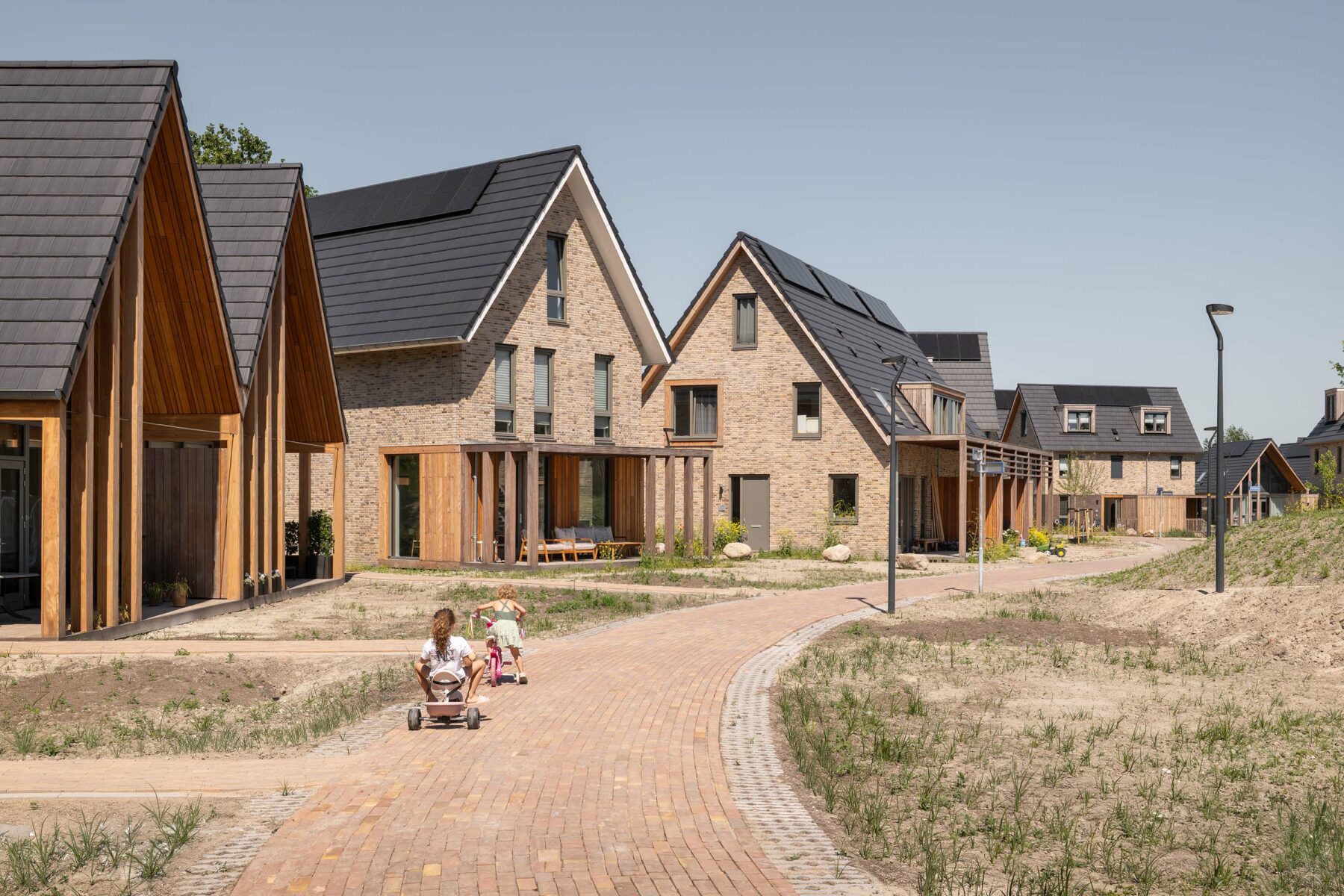
The gardens may well be the most underestimated habitat. Despite their limited size, they prove to be remarkably species-rich. This is undoubtedly influenced by the fact that many observations made by residents take place around their homes. In particular, the decision to plant hedges instead of traditional garden fences has had a significant impact on biodiversity. These (privet) hedges provide shelter and food for species such as the dunnock. At the same time, the gardens are also the most “managed” system: residents’ choices (such as creating open gardens with extensive paving) have a direct influence on ecological quality.
The house sparrow, the ambassador species for this location, has not yet been recorded. We expect that its arrival may still take some time. Relatively few house sparrows are currently found in the surrounding neighbourhoods as well. This is probably because house sparrows often struggle to nest in modern housing developments. We hope that the many nest boxes installed for house sparrows as part of this project will help change that. House sparrows require diverse grassland with a variety of seed-producing plants, which has not yet fully developed. During the breeding season, they also depend on abundant insects to feed their chicks. During a follow-up survey, the nest boxes will be checked for occupancy, and we hope to record the presence of house sparrows.
The diversity of species observed across the different habitats is promising, but it also shows that the neighbourhood is still in an early stage of ecological development. We are becoming increasingly aware that a habitat cannot be created on the drawing board alone; above all, it needs time to mature. In the coming articles, we will continue to monitor how this designed landscape gradually transforms into a fully functioning ecosystem. We will also compare the neighbourhood with “traditional” residential areas and undeveloped sites to identify lessons for future nature-inclusive designs.
All observations can also be viewed online via this link: https://waarneming.nl/bioblitz/18924/bioblitz-happy-days-zoetermeer/