Design methodology for ‘The Happy City’
- Article
- Knowledge

LDE InnovationLAB ‘The Happy City’
Over the next four years, I will initiate and organise the LDE InnovationLAB for 24 honours students from Leiden University, Delft University of Technology and Erasmus University Rotterdam. The LDE InnovationLAB aims to build a bridge between students, PhD candidates, professors and innovative start-ups. The lab has been set up as a weekly open studio in a workshop setting, bringing together renowned thinkers, researchers, businesses and students.
We are now one year into the programme, and the first insights are beginning to emerge. Today, I would like to share some of the underlying design methodology and theories that inform our work.
The Happy City and Urban Planning
It seems clear to me that we are at the beginning of a new phase. In my view, the design and process methodology used in spatial planning needs a complete overhaul and can be reinvented from the ground up. Almost all professionals working in spatial planning are unfamiliar with the underlying theories of well-being and invariably approach a challenge from a physical perspective. Yet it turns out that the physical appearance of our surroundings has only a very limited effect on our sense of happiness.
Physical appearance is not the deciding factor
This is a difficult conclusion to accept, at least for designers who believe that the physical form of the city determines our happiness. Even more than popular books on happiness published in recent years, such as Alain de Botton’s The Architecture of Happiness and Charles Montgomery’s Happy City, might lead us to believe, the greatest influence on our own happiness lies not in the physical appearance of our surroundings, but largely in our intentional activities.
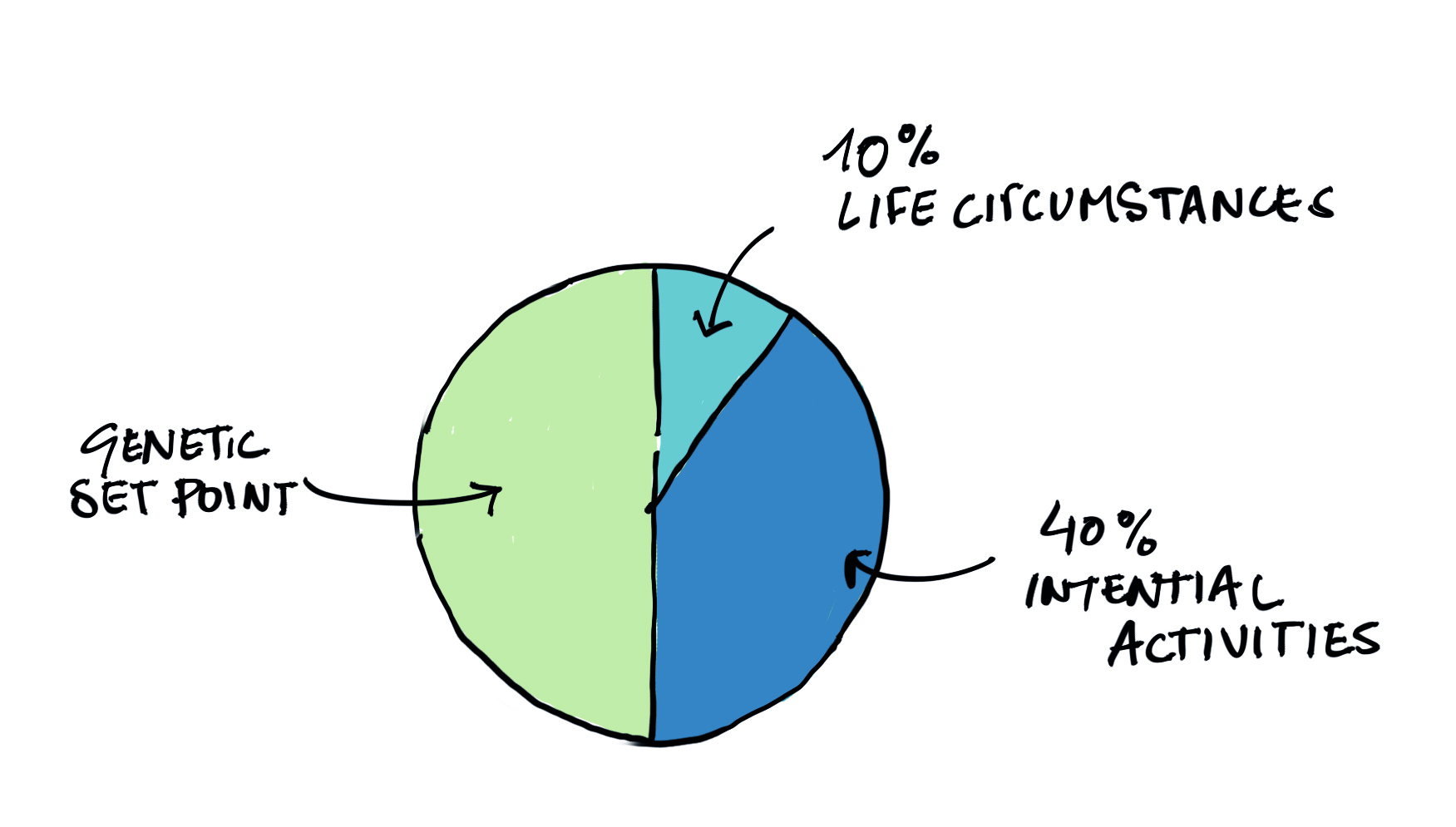
The figure below illustrates the factors that determine our happiness: 50% is genetically determined, while 10% is attributed to ‘life circumstances’, such as age, income, buying a new car, moving to a new neighbourhood or getting new colleagues.
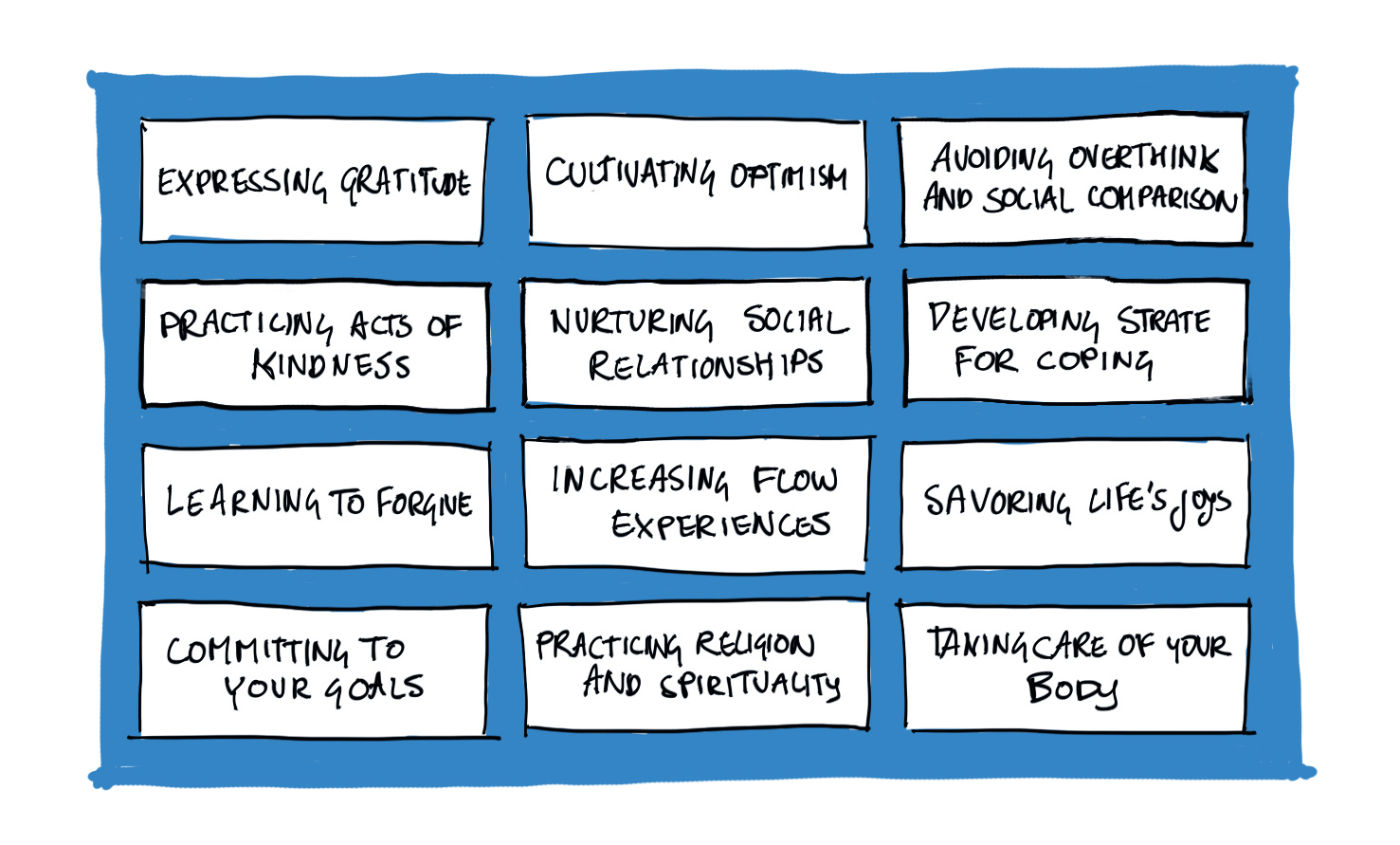
The remaining 40% is attributed to intentional activities: things people consciously engage in, even when they have become part of their everyday routines. Examples include maintaining relationships, learning to forgive, achieving personal goals, taking good care of one’s body, developing optimism, and limiting social comparison and rumination.
Like a rat on a treadmill
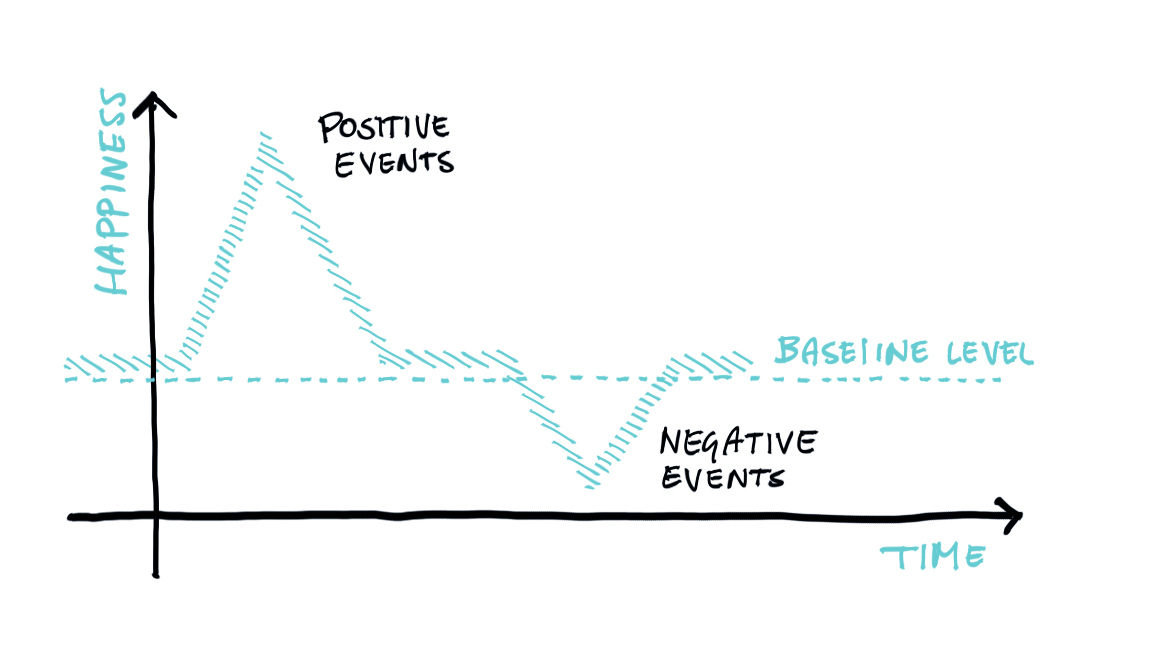
This may feel counterintuitive. We all know how happy we feel when we have just bought a new car, received a pay rise or moved to a luxurious, green residential neighbourhood. Yet the impact on our happiness gradually fades because we quickly become accustomed to our new circumstances.
This phenomenon is known as the ‘hedonic adaptation effect’, illustrated in Figure 2. It means that people have a natural and automatic tendency to adapt to new circumstances. This has an important benefit: negative feelings, too, do not last forever.
People who pursue happiness by buying lots of possessions are like rats on a treadmill: they keep running but ultimately get nowhere.
Pleasure and meaning
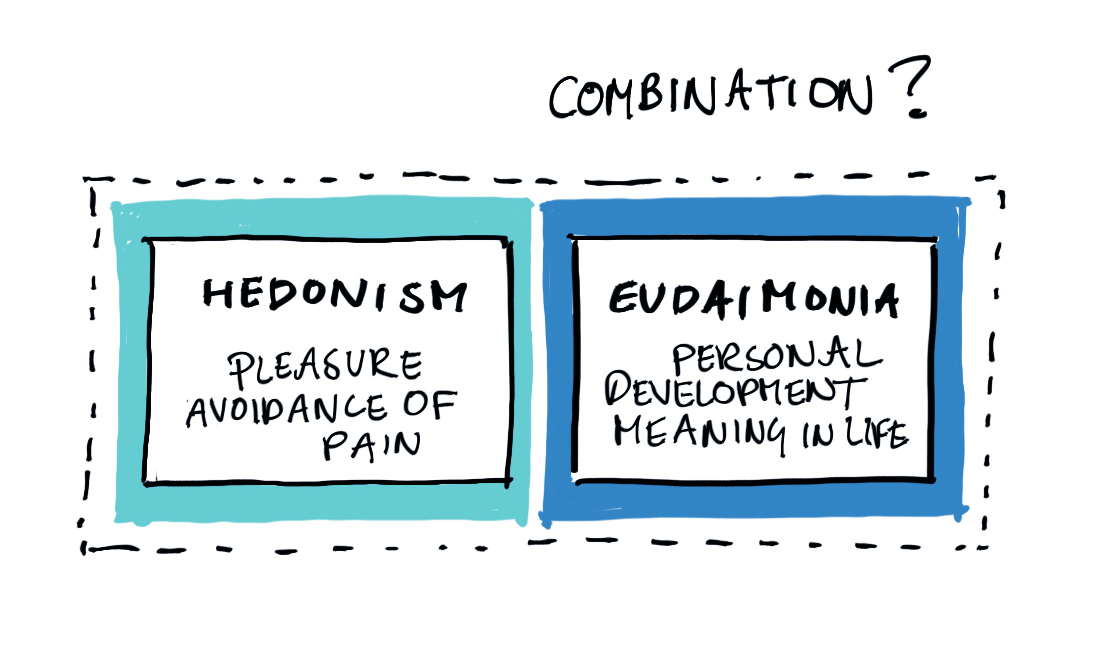
The distinction between ‘life circumstances’ and ‘intentional activities’ can also be related to the apparent contrast between hedonism and eudaimonia, as illustrated in Figure 3.
Hedonism involves pursuing happiness through pleasure, stimulation, taste and, for example, a pleasant physical environment. From this perspective, happiness is the sum of the pleasurable stimuli experienced by an individual. The focus is on the here and now and on the short term.
Eudaimonic theories, by contrast, are based on the idea that people need to work towards developing their talents and finding meaning in life over the long term. We can view these perspectives as opposites, but many argue that true happiness lies in a combination of the two.
Virtue
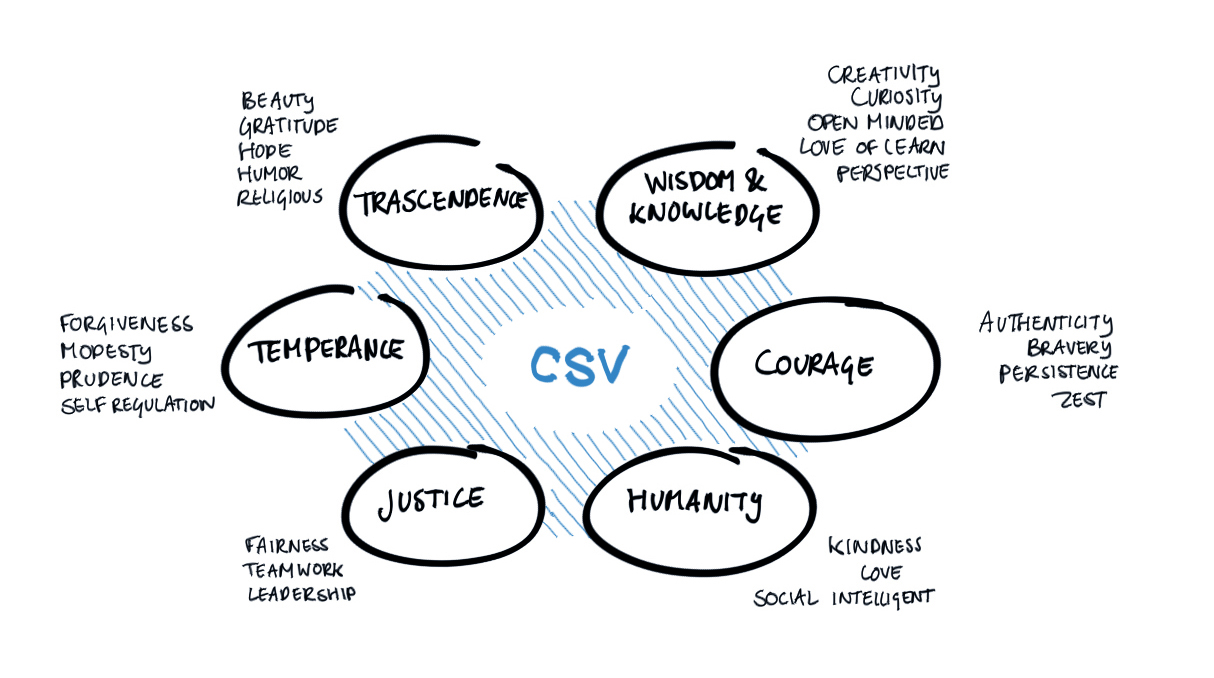
Alongside ‘pleasure’ and ‘meaning’, scientific theories of happiness identify a third dimension: ‘virtue’, as illustrated in Figure 4.
Twenty-four character strengths and six virtues have been identified across major religions and various cultural traditions. They are generally regarded as character traits and virtues that can be cultivated and are universally recognised as facets of what it means to be ‘a good person’.
The InnovationLAB Design Methodology: The Positive Design Framework
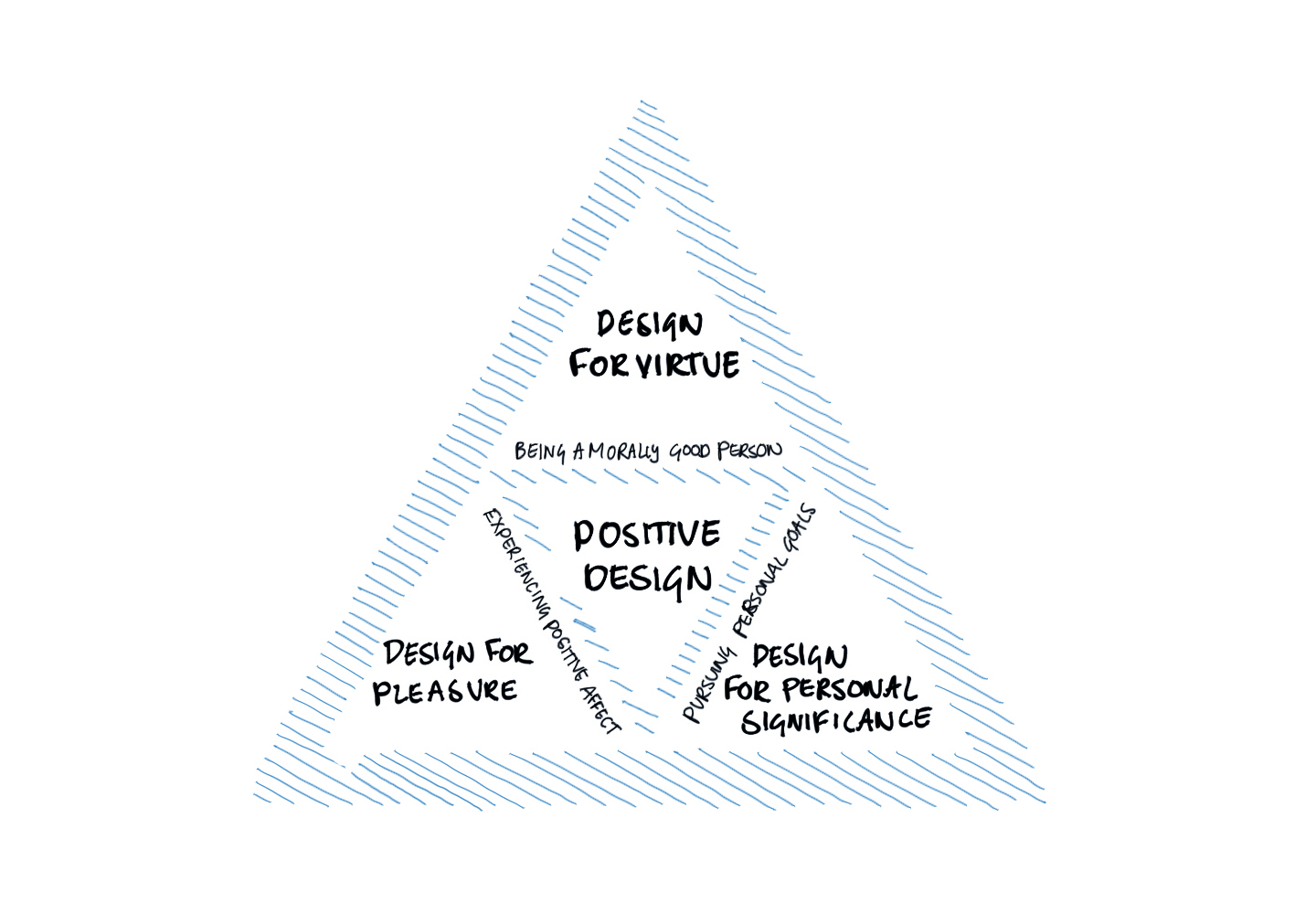
The Positive Design Framework (Figure 5) was introduced in 2013 by Professor Pieter Desmet, an ambassador for the InnovationLAB, and Anna Pohlmeyer. It is a design methodology that combines all the theories outlined above and brings them together within an integrated, overlapping structure.
The Positive Design Framework has been used in the InnovationLAB over the past year. The aim of designing for happiness is to operate within the area where ‘pleasure’, ‘meaning’ and ‘virtue’ overlap. This can be achieved by combining the different ingredients in a harmonious way.
The Social and societal dimension
We can exert considerable influence in the social and societal domain. This is where we need to start, allowing the physical dimension to develop from there.
This is also reflected in the diverse ideas and insights generated by the students over the past year. Not one of their proposals was a traditional urban design plan. It is not about the articulation of a façade, introducing more greenery, or designing a small public square at a human scale.
User research, interviews, co-creation sessions and the positive design framework in the city
The challenge is to discover how people can continue to develop their talents over the long term, how they can find greater meaning in their lives, and how consumption and status derived from ownership can become less important.
At the same time, we need to explore how people can experience more stimulation, pleasure, comfort and safety in the short term, while enabling as many people as possible to lead virtuous lives.
More opportunities to be yourself
By maintaining an ongoing dialogue with people in the city, ideas begin to emerge that focus more on intentional activities and on programming the city in ways that incorporate the ingredients described above. They also focus on creating opportunities for meaningful encounters and on designing situations in which people can be more fully themselves.
Information and technology
These aspirations can be translated into new spatial interventions. However, they can also be realised by opening up vacant buildings, unfamiliar spaces, areas and neighbourhoods that have previously been inaccessible or unknown to potential users.
We see the city as a set of (social) systems within which various actors can play a role and a wide range of structures are already in place, ready to be activated to further unlock individual and collective happiness.
I am delighted that we are only just getting started and still have four years ahead of us to continue researching and experimenting. Several interested municipalities and housing associations are already approaching us to discuss our new insights and ideas.
The proof of success? Trying things out and experimenting.
We now have enough students, professionals and researchers ready to make a difference. The Happy City is certainly a goal in its own right, but above all, it is an approach that encourages many people, myself included, to think differently and collaborate in new ways.